Shadow SimulatorWatch a shadow swing and stretch through the day.
3:00 PM.A 1 m stick casts a 1 m shadow to the northeast.
Drag the ground to turn it. Time here is the Sun's own: noon is when the Sun is highest, which can differ from the clock.
A shadow points away from the Sun, and its length depends on how high the Sun stands. Shadows are longest near sunrise and sunset and shortest at solar noon. The length is the object's height divided by the tangent of the Sun's height.
Try this.
- Press Play the day. When is the shadow longest? When is it shortest?
- Change the object from a stick to a building. Does the shape of the tip's path change, or only its size?
- Choose Honolulu and the June solstice. What happens to the shadow at noon?
- Press Draw a sundial. Why are the hour lines not evenly spaced?
- Go outside with a stick and a tape measure. Does your shadow match the simulator?
Read an hour from a real shadow.
The Gnomon is a free daily game from Sol: a famous building under the day's sun, and a secret hour to work out from its shadow. Everyone plays the same one each day.
What's happening.
How do you work out a shadow's length?
Divide the object's height by the tangent of the Sun's height. When the Sun stands at 45 degrees, a 1 m stick casts a 1 m shadow. At 30 degrees, it casts about 1.7 m, and at 10 degrees about 5.7 m.
Which way does a shadow point?
Directly away from the Sun. In the Northern Hemisphere outside the tropics, the shadow swings from west through north to east during the day, which is the direction a clock's hands turn.
Why are shadows shorter in summer?
The Sun stands higher in the sky. In New York at noon, a 1 m stick casts a shadow of about 0.3 m in June and about 2 m in December.
Can a shadow disappear?
Yes, in the tropics. When the Sun stands directly overhead, a post casts no shadow beyond its own base. Honolulu sees this twice a year, in May and July.
How does a sundial work?
The shadow of a fixed post falls in a different direction each hour. Mark those directions on the ground and the shadow tells the time. A sundial works only for the latitude it was laid out for, and it reads the Sun's time, not the clock's.
How did shadows measure the Earth?
About 2,200 years ago, Eratosthenes compared the noon shadows at two cities on the same day. In one there was no shadow, and in the other the Sun stood about 7 degrees from overhead. That difference, and the distance between the cities, gave him a close estimate of the planet's size.
Common mix-ups.
It swings through the day as the Sun moves across the sky. Play the day and watch it turn.
They are shortest at solar noon, when the Sun is highest. On a clock that can be an hour or more from 12:00.
Its path has the same shape at a larger size. Height multiplies the length and leaves the direction alone.
Any strong enough light makes a shadow. Moonlight does too, if you look on a clear night at full moon.
For teachers.
Grades 3 to 7. 15 to 30 minutes. Students need no account, and the page collects nothing about them.
Standards
- 5-ESS1-2
- Show daily changes in the length and direction of shadows in graphical displays
- 1-ESS1-1
- Describe patterns of the Sun's motion that can be predicted
Discussion questions, with answers
- At what Sun height is a shadow as long as the object is tall?
- 45 degrees.
- In New York, at what time of day is your shadow pointing due north?
- At solar noon, when the Sun is due south.
- Why does the tip of a shadow trace a curve and not a straight line?
- The Sun's height and direction change together through the day. Only on the equinoxes is the tip's path a nearly straight line.
- A 2 m post casts a 3 m shadow. How high is the Sun?
- The tangent of the Sun's height is 2 divided by 3, so it stands about 34 degrees up.
Embed it in your class page
Paste this into Google Classroom, Canvas, Schoology or your own site.
<iframe src="https://initial.app/embed/shadows" title="Shadow Simulator" width="100%" height="760" style="border:0" loading="lazy" allowfullscreen></iframe>
<p><a href="https://initial.app/shadows">Shadow Simulator</a> from Initial</p>Keep exploring.
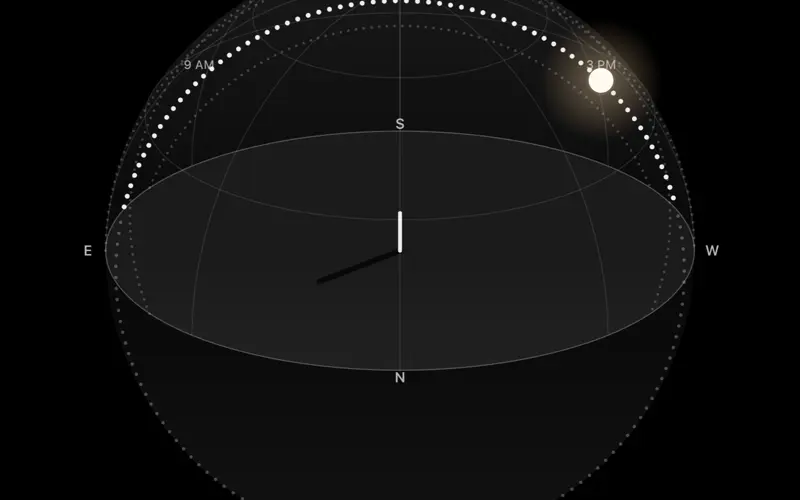
Sun Path Simulator
See the Sun's arc across your sky for any latitude and date, from the equator to the pole.
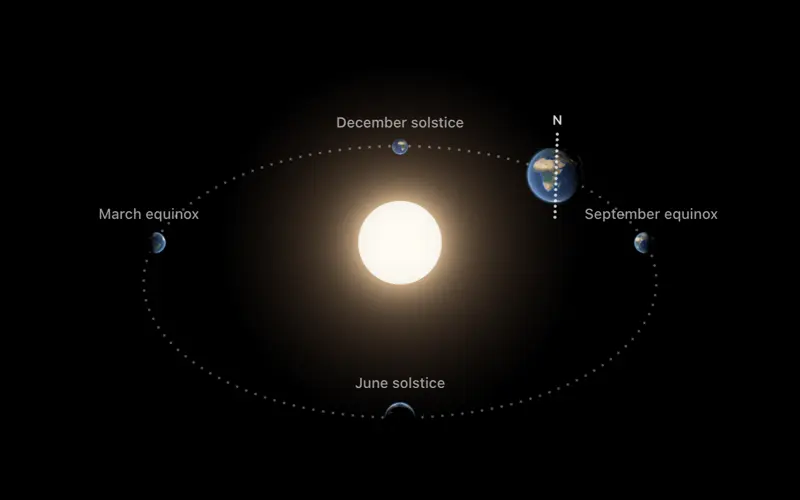
Seasons Simulator
Move Earth around the Sun, change its tilt, and watch the days and the heat follow.
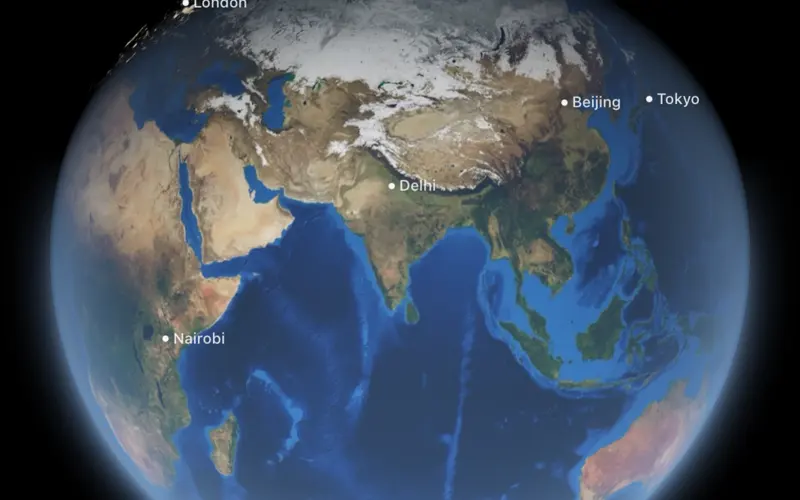
Day and Night Simulator
Spin Earth and see where it is day and night right now, on a globe and a map.