Day and Night SimulatorSee where it is day and night right now, then spin Earth yourself.
Right now.The Sun is overhead.
Drag the globe to turn it. The day and night stay where the Sun puts them, as they do in space.
Day and night happen because Earth spins once every 24 hours. At any moment the Sun lights half of Earth. Where you stand turns into that light in the morning and out of it in the evening.
Try this.
- Press Right now. Find where you live. Are you in the day half or the night half?
- Press Spin Earth and watch your city. Which way does the morning line move?
- Choose the June solstice. Look at the Arctic and at Antarctica. What do you notice?
- Find two cities on the list where it is day in one and night in the other. How far apart are they?
See your own day, minute by minute.
Sol shows when your sun rises and sets, how the day's length is changing, and how the time compares between any two places.
What's happening.
What causes day and night?
Earth spins on its axis once every 24 hours. The half that faces the Sun has day, and the other half has night. The Sun isn't moving across the sky. You are turning under it.
Why does the Sun rise in the east?
Earth spins toward the east. As you turn, the Sun comes into view on your eastern horizon and later drops behind your western one.
How fast is Earth spinning?
At the equator, the ground moves at about 1,670 km an hour. In New York it moves at about 1,270 km an hour, and at the poles it barely moves at all. You don't feel it, because the air and everything around you move with you.
Why is the line between day and night slanted?
Earth's axis is tilted 23.4 degrees. Near the solstices the tilt carries one pole into constant daylight and the other into constant dark, so the line slants across the map. At the equinoxes it runs close to north and south.
Why aren't all days 12 hours long?
The tilt means a place spends more of each turn in the light when its half of Earth leans toward the Sun. Only the equator stays close to 12 hours all year.
Why do we have time zones?
Noon comes when the Sun is highest, and that happens at different moments around the world. Time zones give places roughly their own noon, so clocks stay close to the Sun, though some are hours off.
Common mix-ups.
Earth turns, and the Sun stands still in the sky around us. It looks as though the Sun moves, in the way a street seems to move past a train.
Going around the Sun takes a year, and it brings the seasons. One day and night is one spin on Earth's axis.
The Sun keeps shining. At night your side of Earth has turned away from it, while the other side is in daylight.
When it is noon in London it is morning in New York, and evening in Tokyo. Look at the list beside the globe.
For teachers.
Grades 1 to 6. 15 to 20 minutes. Students need no account, and the page collects nothing about them.
Standards
- 5-ESS1-2
- Show daily patterns of day and night, and of shadows
- 1-ESS1-1
- Describe patterns of the Sun's motion that can be predicted
- England, Year 5
- Use Earth's rotation to explain day and night and the Sun's apparent movement
Discussion questions, with answers
- If it is noon where you are, what time is it on the exact opposite side of Earth?
- About midnight.
- Why does the North Pole have no sunset in June?
- The north leans toward the Sun, so the pole stays in the light as Earth turns.
- About how much of Earth is in daylight at any moment?
- About half, on any date.
- Which direction does the line of sunrise move across the map?
- West. Sunrise reaches eastern places first.
Embed it in your class page
Paste this into Google Classroom, Canvas, Schoology or your own site.
<iframe src="https://initial.app/embed/day-and-night" title="Day and Night Simulator" width="100%" height="760" style="border:0" loading="lazy" allowfullscreen></iframe>
<p><a href="https://initial.app/day-and-night">Day and Night Simulator</a> from Initial</p>Keep exploring.
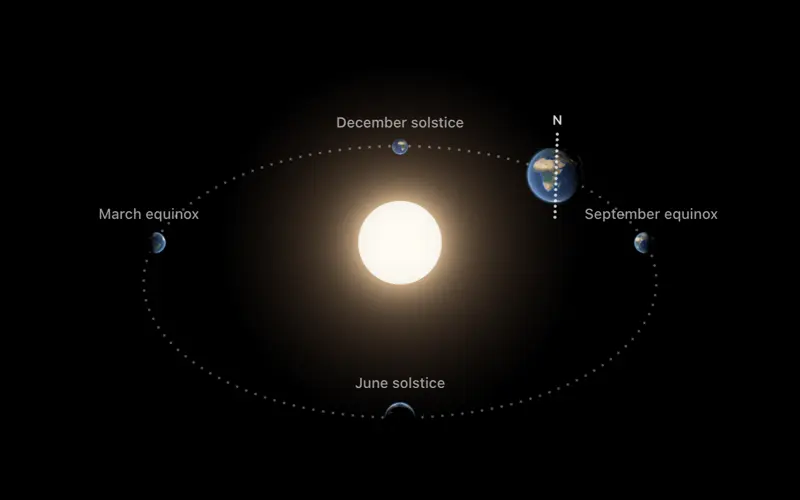
Seasons Simulator
Move Earth around the Sun, change its tilt, and watch the days and the heat follow.
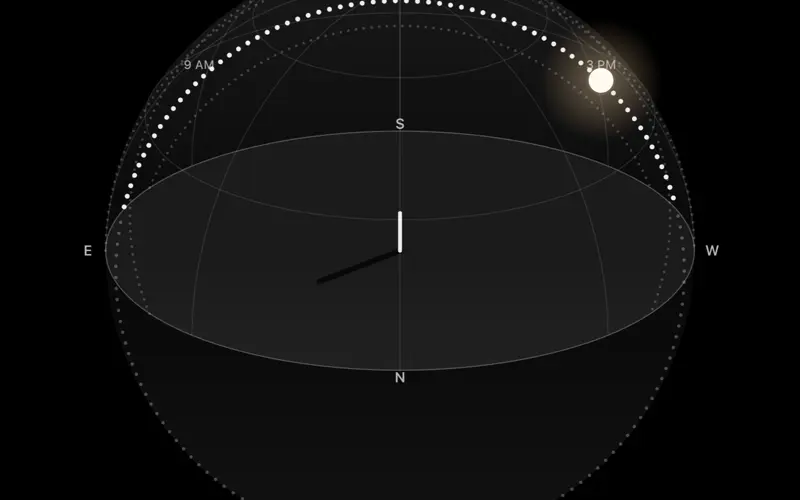
Sun Path Simulator
See the Sun's arc across your sky for any latitude and date, from the equator to the pole.
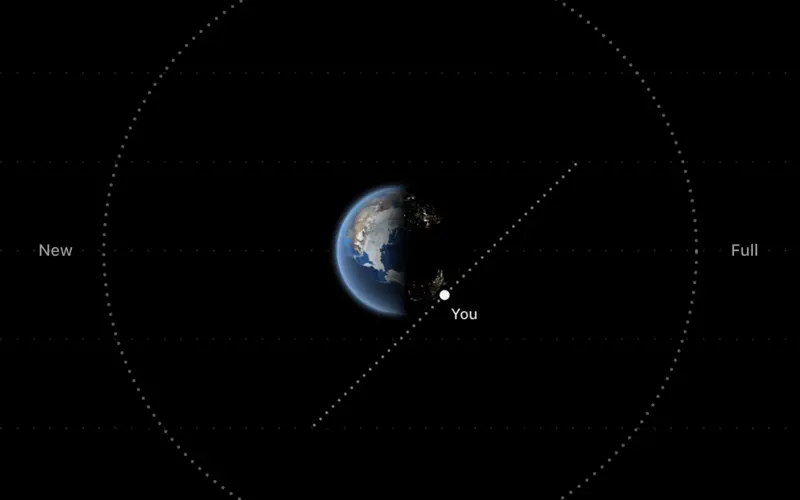
Moon Phases Simulator
Drag the Moon around Earth and see every phase from above and from the ground.