Seasons SimulatorMove Earth around the Sun, and change its tilt.
June 21.Summer in the north, winter in the south.
Earth from the side. The bright line is your latitude in daylight, and the faint line is its night.
The Sun's path over you today. The faint paths are the solstices and the equinox.
Earth and the Sun are drawn far larger than they are, and the orbit looks like a circle because it nearly is one. The Sun's height and the day's length are true for each date. Sunlight on the ground is the share of an overhead Sun's light that falls on level ground at noon.
Seasons happen because Earth's axis is tilted 23.4 degrees. For part of the year your half of Earth leans toward the Sun, so the Sun climbs higher and stays up longer. Distance has almost nothing to do with it: Earth is closest to the Sun in January.
Try this.
- Choose No tilt and play the year. What happens to the day's length? To the Sun's height?
- Choose New York. Compare the daylight in June and December, then explain the difference from the side view.
- Keep the same date and choose Sydney. Why is it summer there when it is winter in New York?
- Find the day Earth is closest to the Sun. What season is it in New York that day?
- Choose 90°, on its side, and the North Pole. What would a year be like?
See when the seasons turn in your city.
Sol gives the exact moment each season starts where you live, how the day's length is changing, and when the evenings come back.
What's happening.
Why do we have seasons?
Earth's axis is tilted 23.4 degrees, and it keeps pointing the same way as Earth goes around the Sun. In June the north leans toward the Sun, and in December the south does. The half that leans toward the Sun gets it higher in the sky and for more hours a day, so it warms up.
Why does a higher Sun feel hotter?
A high Sun packs the same sunlight into a smaller patch of ground. When the Sun stands at 30 degrees, each square meter gets half of what it would under an overhead Sun. The Sun's rays also cross less air on the way down.
Is Earth closer to the Sun in summer?
No. Earth is closest to the Sun around January 3, at about 147 million km, and farthest in early July, at about 152 million km. That is winter in the north. The difference is small, about 3 percent, and the tilt matters far more.
Why are the seasons opposite in the two hemispheres?
When the north leans toward the Sun, the south leans away. So June is winter in Sydney and Buenos Aires, and December is summer there.
What are solstices and equinoxes?
A solstice is when one half of Earth leans most toward the Sun, about June 21 and December 21. An equinox is when neither half leans toward it, about March 20 and September 22. Day and night are then close to equal everywhere.
Why isn't the hottest day on the longest day?
Land and sea take weeks to warm up and cool down. In most places the warmest weeks come a month or more after the June solstice, and the coldest come after the December solstice. The clock has its own lag: the earliest sunset comes weeks before the shortest day.
Common mix-ups.
Earth is closest to the Sun in early January. If distance caused the seasons, the whole planet would have summer at once, and it doesn't.
The tilt stays the same all year, pointing the same way in space. What changes is where Earth is on its orbit, and so which half is leaning toward the Sun.
The north is only a few thousand km closer than the south, out of 150 million. The difference comes from the angle of the light and the length of the day.
Only in the tropics. In New York the highest the Sun ever gets is about 73 degrees. Try it with the slider.
For teachers.
Grades 4 to 9. 20 to 30 minutes. Students need no account, and the page collects nothing about them.
Standards
- MS-ESS1-1
- Model the Earth-Sun-Moon system to describe seasons
- 1-ESS1-2
- Relate the amount of daylight to the time of year
- England, Year 5
- Describe the movement of the Earth relative to the Sun
Discussion questions, with answers
- What would happen if Earth had no tilt?
- Days would be 12 hours everywhere, all year, and the Sun's height at noon would never change. There would be no seasons to speak of.
- Where on Earth is the day's length steady all year?
- At the equator, where it stays close to 12 hours.
- Why does the North Pole have one long day each year?
- From March to September the north leans toward the Sun, and the pole stays in sunlight as Earth turns. Then it stays in darkness for the other half of the year.
- How much less sunlight does New York's ground get at noon in December than in June?
- The Sun stands at about 26 degrees in December and 73 degrees in June, so the ground gets about 44 percent of an overhead Sun's light against 95 percent: less than half.
Embed it in your class page
Paste this into Google Classroom, Canvas, Schoology or your own site.
<iframe src="https://initial.app/embed/seasons" title="Seasons Simulator" width="100%" height="760" style="border:0" loading="lazy" allowfullscreen></iframe>
<p><a href="https://initial.app/seasons">Seasons Simulator</a> from Initial</p>Keep exploring.
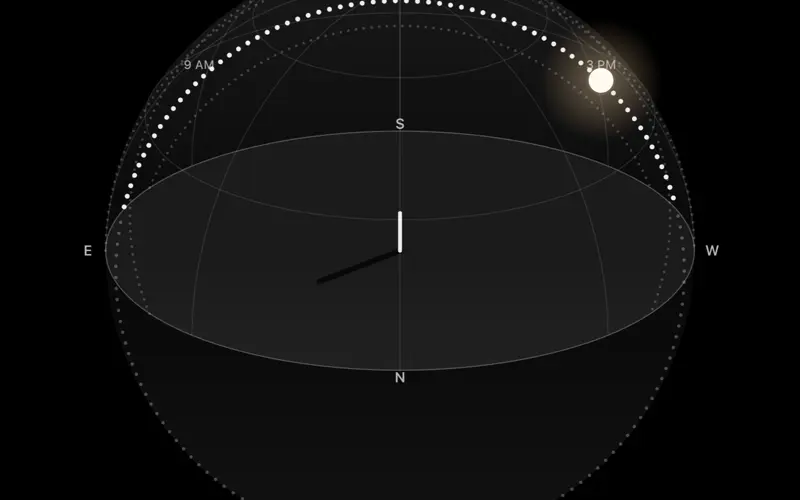
Sun Path Simulator
See the Sun's arc across your sky for any latitude and date, from the equator to the pole.
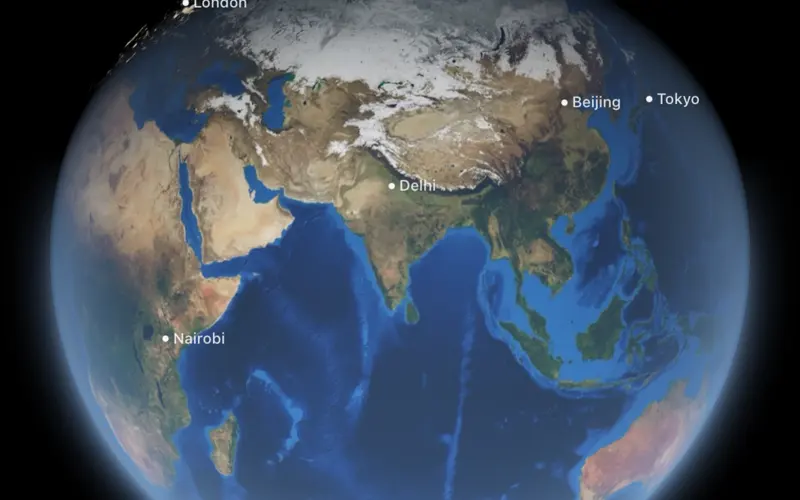
Day and Night Simulator
Spin Earth and see where it is day and night right now, on a globe and a map.
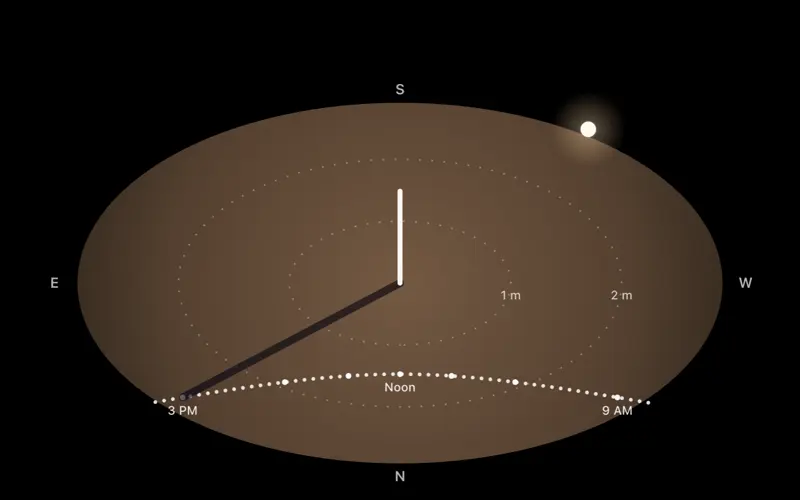
Shadow Simulator
Watch a shadow swing and stretch through the day, and trace a sundial on the ground.