Solar System Scale Model CalculatorChoose a size for the Sun, and everything else follows.
If the Sun were a basketball.Earth is 2.2 mm across, 26 m away.
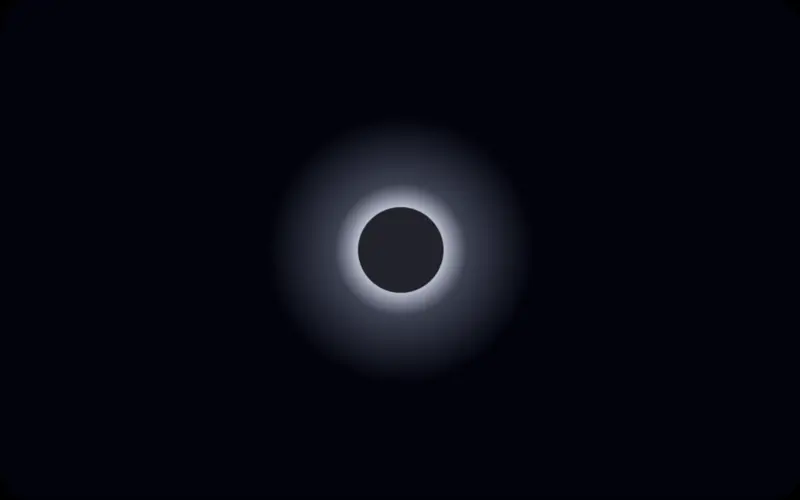
Sizes, to scale. Only the Sun's edge fits.
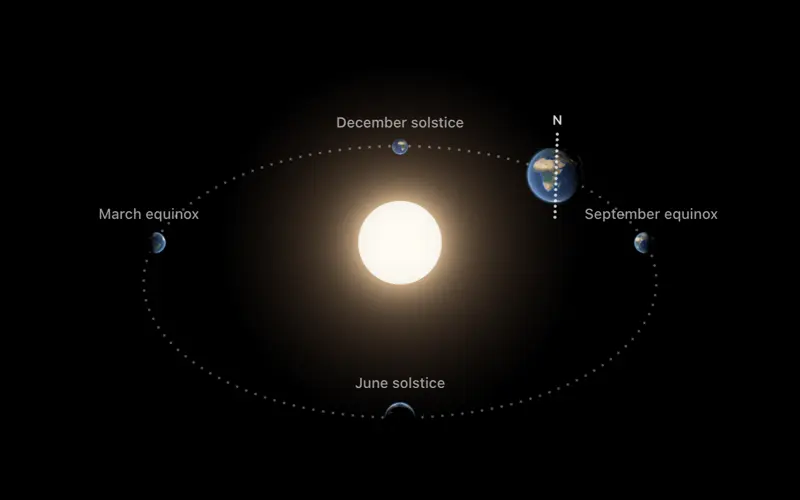
Distances, to scale. At this scale every planet would be far too small to see.
| Planet | Size at this scale | About the size of | Distance from the Sun |
|---|---|---|---|
| Mercury | 0.8 mm | a poppy seed | 10 m |
| Venus | 2.1 mm | a grain of rice's width | 19 m |
| Earth | 2.2 mm | a grain of rice's width | 26 m |
| Mars | 1.2 mm | a poppy seed | 39 m |
| Jupiter | 2.5 cm | a grape | 134 m |
| Saturn | 2.1 cm | a grape | 247 m |
| Uranus | 8.8 mm | a pea | 495 m |
| Neptune | 8.5 mm | a pea | 775 m |
Sizes and mean distances come from NASA's Planetary Fact Sheet. Planets move, so they are never in a line.
If the Sun were a basketball, Earth would be 2.2 millimeters across, about the size of a grain of rice's width, and 26 meters away. Neptune would be 775 meters away. The planets are tiny and the gaps are enormous, and no drawing in a textbook can show both at once.
Try this.
- Choose A basketball. Pace out the distance to Earth in your classroom or hallway. Where does Mars fall? Does Jupiter fit in the building?
- Choose A marble. Could you fit all the planets on your school's grounds?
- Find a small object for each planet from the table, then walk the solar system outside.
- Use the distance to the nearest star. Which real place is about that far from your school?
See the planets where they really are today.
Sol's Orbit tab puts the planets on their real paths at the real moment, and the Almanac is a free daily game about the sky over a city.
What's happening.
How big is the solar system, to scale?
If the Sun were a basketball, Mercury would be 10 meters away, Earth 26 meters, Jupiter 134 meters and Neptune 775 meters. The nearest other star would be about 6,900 kilometers away: across a continent.
How do you make a scale model of the solar system?
Pick a size for the Sun. Divide that size by the Sun's real diameter, 1,392,700 km, to get your scale. Multiply each planet's real size and real distance by that scale. The table here does the sums, and the worksheet takes students through doing them by hand.
Why do drawings of the solar system look so crowded?
On a page, a true-scale distance would make every planet too small to see, and a true-scale planet would put Neptune many meters off the edge. A drawing shows either sizes or distances, never both, and most make the planets huge and the gaps small.
How long does sunlight take to reach each planet?
About 3 minutes to Mercury, 8 minutes 20 seconds to Earth, 43 minutes to Jupiter, and just over 4 hours to Neptune. Light travels 300,000 km every second.
How big is Earth next to the Sun?
The Sun is about 109 times as wide as Earth, and about 1.3 million Earths would fit inside it.
Common mix-ups.
The gaps are vast. Between Earth and Mars alone, at the closest they ever come, you could fit Earth about 4,400 times over.
Each goes around the Sun at its own pace, so they are spread around the Sun in every direction. They never line up as in a diagram.
Its rocks are so far apart that spacecraft cross it with no danger. On a basketball-sized Sun, you would not find any of them.
The Sun is about 10 times as wide as Jupiter, and about 1,000 Jupiters would fit inside it.
For teachers.
Grades 5 to 9. 20 to 45 minutes. Students need no account, and the page collects nothing about them.
Standards
- MS-ESS1-3
- Analyze and interpret data to determine scale properties of objects in the solar system
- 5-ESS1-1
- Argue that the Sun's apparent brightness is due to its distance from Earth
Discussion questions, with answers
- If the Sun is a basketball, what fits in a classroom?
- The Sun and possibly nothing else: even Mercury is 10 meters away.
- Why is the nearest star so hard to reach in the model?
- It is about 4.2 light-years away, and at this scale that is about 6,900 km.
- How much bigger is Jupiter than Earth?
- About 11 times as wide.
- What scale is a basketball Sun?
- 24 cm stands for 1,392,700 km, so 1 cm stands for about 58,000 km.
Embed it in your class page
Paste this into Google Classroom, Canvas, Schoology or your own site.
<iframe src="https://initial.app/embed/solar-system-scale" title="Solar System Scale Model Calculator" width="100%" height="760" style="border:0" loading="lazy" allowfullscreen></iframe>
<p><a href="https://initial.app/solar-system-scale">Solar System Scale Model Calculator</a> from Initial</p>