Eclipse SimulatorLine up the Sun, Earth and Moon, and see why most months miss.
Total solar eclipse.At new moon.
Earth and the Moon are drawn far larger and closer than they are, and the Moon's orbit is drawn at more than twice its tilt, so you can see it. The readout and the view from the ground use the true sizes and the true 5-degree tilt. Never look at the Sun without certified eclipse glasses (ISO 12312-2).
An eclipse happens when the Sun, Earth and Moon line up. A solar eclipse is the Moon blocking the Sun, at new moon. A lunar eclipse is the Moon passing through Earth's shadow, at full moon. Most months they miss, because the Moon's orbit is tilted 5 degrees.
Try this.
- Press Line them up. Then play the year. How much of the year has no eclipse?
- Start with Moon near, then choose Moon far. What happens to the total eclipse?
- Choose At full moon: lunar and press Play the eclipse. Why does the Moon turn red?
- Slide the time of year away from zero until the eclipse stops. How far can you go?
See the sky an eclipse will happen in.
Sol draws eclipses in its live sky, along with tonight's Moon and the Sun's path, for the place you choose.
What's happening.
Why isn't there an eclipse every month?
The Moon's orbit is tilted about 5 degrees from Earth's orbit. At most new and full moons the Moon passes above or below the Sun's line, and its shadow misses. An eclipse happens only when the new or full moon falls close to where the two orbits cross, which is twice a year.
What is the difference between a solar and a lunar eclipse?
In a solar eclipse the Moon moves between the Sun and Earth, and its shadow falls on Earth. In a lunar eclipse Earth moves between the Sun and the Moon, and its shadow falls on the Moon.
What is the difference between a total and an annular eclipse?
The Moon's orbit is an oval. When the Moon is near, it looks a little larger than the Sun and can cover it fully. When it is far, it looks smaller, and a ring of Sun stays around it.
Why does the Moon turn red in a lunar eclipse?
Sunlight passing through Earth's air loses its blue and bends into the shadow, as if lit by every sunset and sunrise on Earth at once. See why in the sky color lab.
Why can more people see a lunar eclipse?
A lunar eclipse can be seen from the whole night side of Earth. A total solar eclipse is seen only along a narrow path where the Moon's dark shadow touches down, usually under 200 km wide.
When are the next eclipses?
February 6, 2027, an annular eclipse over Chile, Argentina and the Atlantic; August 2, 2027, a total solar eclipse crossing southern Spain and North Africa; and July 22, 2028, a total solar eclipse over Australia and New Zealand. The next total lunar eclipse falls on December 31, 2028.
Common mix-ups.
The Moon's tilted orbit makes most new and full moons miss. A year has between two and five solar eclipses, and between two and five lunar ones, counting the faint penumbral kind.
A lunar eclipse needs a full moon, with Earth between the Sun and the Moon. At new moon, the Moon's lit side faces away from Earth, and there is no shadow on it.
A phase is the Moon's own day and night. An eclipse is a shadow from Earth falling across it, and it lasts a few hours.
Any part of the Sun's bright face can hurt your eyes. Use certified eclipse glasses. Only during the brief total phase may you look without them.
For teachers.
Grades 5 to 9. 20 to 30 minutes. Students need no account, and the page collects nothing about them.
Standards
- MS-ESS1-1
- Model the Earth-Sun-Moon system to describe eclipses of the Sun and Moon
- HS-ESS1-4
- Use mathematical representations to predict the motion of orbiting objects
Discussion questions, with answers
- At what phase can a solar eclipse happen? A lunar one?
- New moon for a solar eclipse, and full moon for a lunar one.
- If the Moon's orbit had no tilt, how many eclipses would we get?
- One solar and one lunar eclipse in nearly every month.
- Why do the Moon and the Sun look the same size?
- The Sun is about 400 times as wide as the Moon and about 400 times as far away.
- Why are eclipses grouped in seasons about six months apart?
- Twice a year, the Sun stands near the line where the Moon's orbit crosses Earth's. Any new or full moon in those few weeks can make an eclipse.
Embed it in your class page
Paste this into Google Classroom, Canvas, Schoology or your own site.
<iframe src="https://initial.app/embed/eclipses" title="Eclipse Simulator" width="100%" height="760" style="border:0" loading="lazy" allowfullscreen></iframe>
<p><a href="https://initial.app/eclipses">Eclipse Simulator</a> from Initial</p>Keep exploring.
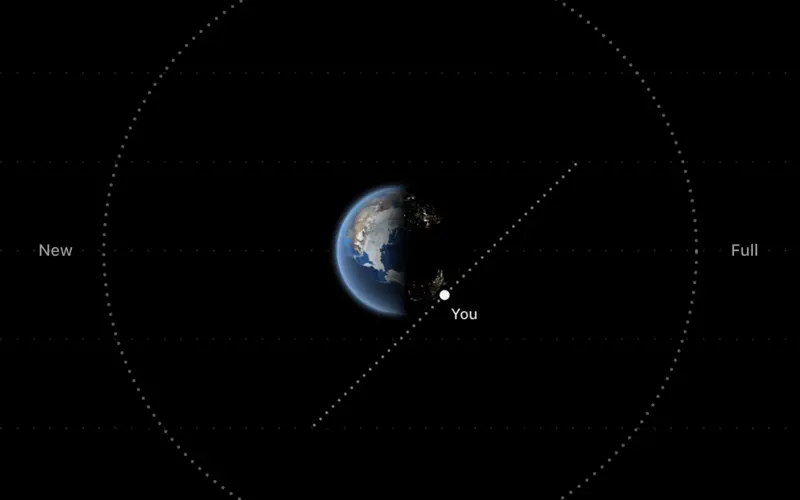
Moon Phases Simulator
Drag the Moon around Earth and see every phase from above and from the ground.
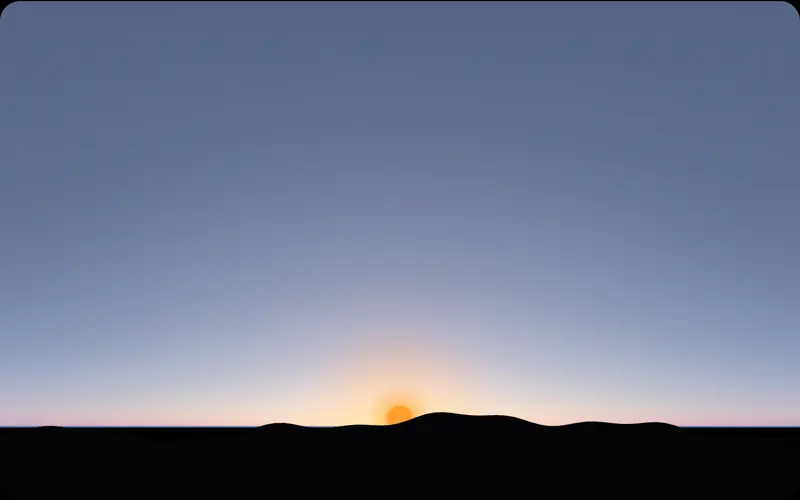
Why Is the Sky Blue?
Move the Sun, change the air, and watch the sky turn from blue to red, or white, or black.
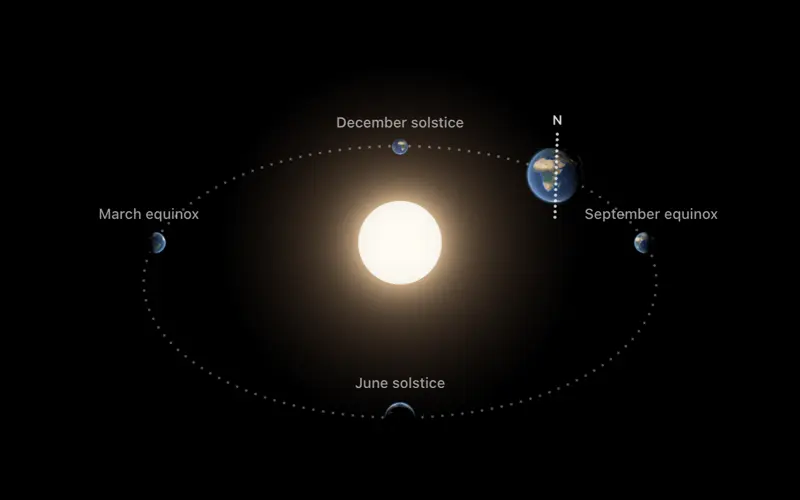
Seasons Simulator
Move Earth around the Sun, change its tilt, and watch the days and the heat follow.